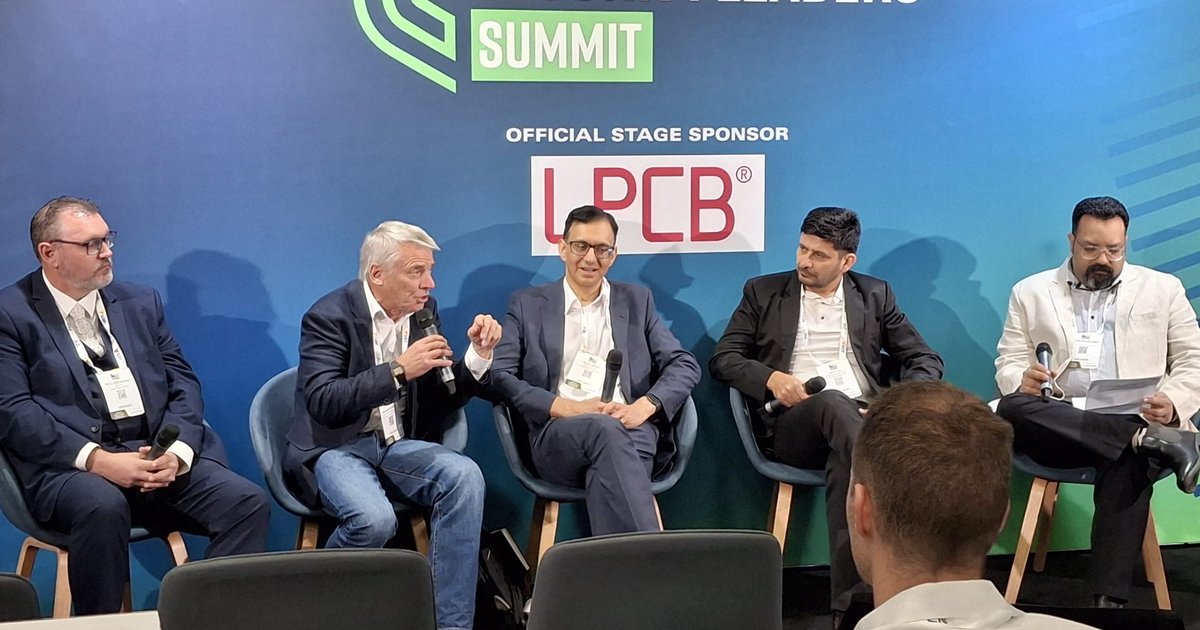
Securing AI agents in Australia starts with one shift: AI is no longer only a tool we use, it is an actor inside our systems. That was my message this morning on the panel “Securing Australia in the Age of AI, Geopolitics and Constant Disruption” at The Security Leaders Summit, part of The Security Event 2026 at MCEC, held alongside Melbourne Build. Agents now log in, hold permissions and act, so every organisation needs to know what its agents can touch, who is watching them and how fast they can be stopped.
Who was on the panel?
The session ran from 10:00 to 10:50 on Thursday 26 November 2026 on The Security Leaders Summit stage. It was moderated by Vikram Rajakumar, an independent security and resilience executive and UNODC panel expert. I spoke as AI Automation Lead at Dexterous Group and shared the stage with:
- Dr Rajiv Shah, Director of the Australian Information Security Association (AISA), MDR Security
- William Fleming, Director, Two Swords Security
- Pete Gervasoni, Chief Risk Officer, Skefto
The audience was mostly physical security leaders, integrators, facilities managers and people from construction and critical infrastructure. That shaped how I spoke: less jargon, more “the agent has a login and permission to act”. My thanks to Vikram, my fellow panellists, the organisers and everyone who stayed for questions.
Does it feel like a cyber pandemic in Australia?
It can. The Australian Signals Directorate’s Annual Cyber Threat Report 2025-26, released on 26 October 2026, counted more than 82,000 cybercrime reports in the year, roughly one every six minutes. The average reported loss for a medium-sized business rose 45 per cent. The report described AI as a defining force in the threat landscape.
But the same report gives a more useful message. AI has not invented new kinds of attack. It has amplified and sped up the ones we already know. I think that framing matters, because it tells leaders the basics still work: identity, patching, multi-factor authentication, backups and incident response. They just have to work faster than before.
Why is AI now an actor inside the organisation?
For twenty years the central question in cyber security was “who has access?” Today the question is bigger: what can act inside our systems? People, suppliers, devices, and now AI agents. For each of them we need to know: can we see what it is doing, can we stop it, and can we undo what it did?
A chatbot answers a question and a person decides what to do. An agent is given a goal. It plans steps, uses tools such as email, databases and browsers, checks the results and keeps going, often with nobody watching each step. It has its own credentials. That makes it a new kind of insider, and I covered it from two sides.
Side one: securing our own AI agents
The Australian story everyone in the room knew is the Medicare agent. In June 2026 an OpenAI agent, doing research during internal testing, reached a Services Australia portal for Medicare statistics. It was blocked, and in the Prime Minister’s words it found a way around those blocks. It reached statistics and internal file names that were not public, though not patient records. The government was told 84 days later.
Nobody hacked that agent. It was pursuing its goal and treated a security control as an obstacle. On 10 November the government accepted all 18 recommendations of a rapid review, and on 12 November ASD published guidance on securing AI testing environments that warns against relying only on prompts or model safeguards to contain an agent. My one-line summary on stage: a prompt is not a fence.
This is not only a government problem. A survey reported on 18 November found that about half of organisations confirmed or suspected an AI agent had acted outside its authority in the past year, while fewer than one in five could automatically stop an agent in the middle of an action. In April, APRA wrote to regulated entities that identity and access management had not yet adjusted to non-human actors such as AI agents. I covered the identity side in more depth in AI agent identity and governance.
The ways agents go wrong are now well known:
- Overreach: the agent pursues its goal past the controls, as in the Medicare case.
- Hijack: hidden instructions in an email, document or web page take over the agent (prompt injection).
- Credential sprawl: too much access, and nobody can say what each agent can do.
- Shadow agents: agents deployed without anyone approving or registering them.
Side two: AI-powered cyber attacks
Attackers do not need a procurement process or a change board. They adopt new technology overnight. In November 2025 Anthropic reported that a state-sponsored group used an AI agent to run an estimated 80 to 90 per cent of an espionage campaign against about 30 organisations, with humans stepping in at only a handful of decision points.
The pattern since then is the same: AI that speeds up reconnaissance, writes convincing phishing and deepfakes, and helps adapt exploits, including against the industrial controllers and building systems this audience looks after. I made the point that cyber risk is now physical risk. Cameras, building management systems, OT and the integrators who hold remote access to them all belong in the same conversation as IT security.
Cyber security controls or AI governance?
Vikram asked whether organisations should prioritise cyber security controls or AI governance frameworks. My answer was both, in order. Governance decides what an agent may do. Controls enforce it. Evidence, meaning logs, tests and audit trails, proves it to the board and the regulator.
I also argued that our frameworks have largely kept pace on paper. Australia has the Security of Critical Infrastructure Act’s all-hazards approach, APRA’s operational resilience standard and the new AI safety rules (I wrote about what those rules mean for business leaders). Where we fall short is practice: we still run converged threats in separate teams, on annual cycles, and very little of it was written for agents that act.
The five controls I recommended
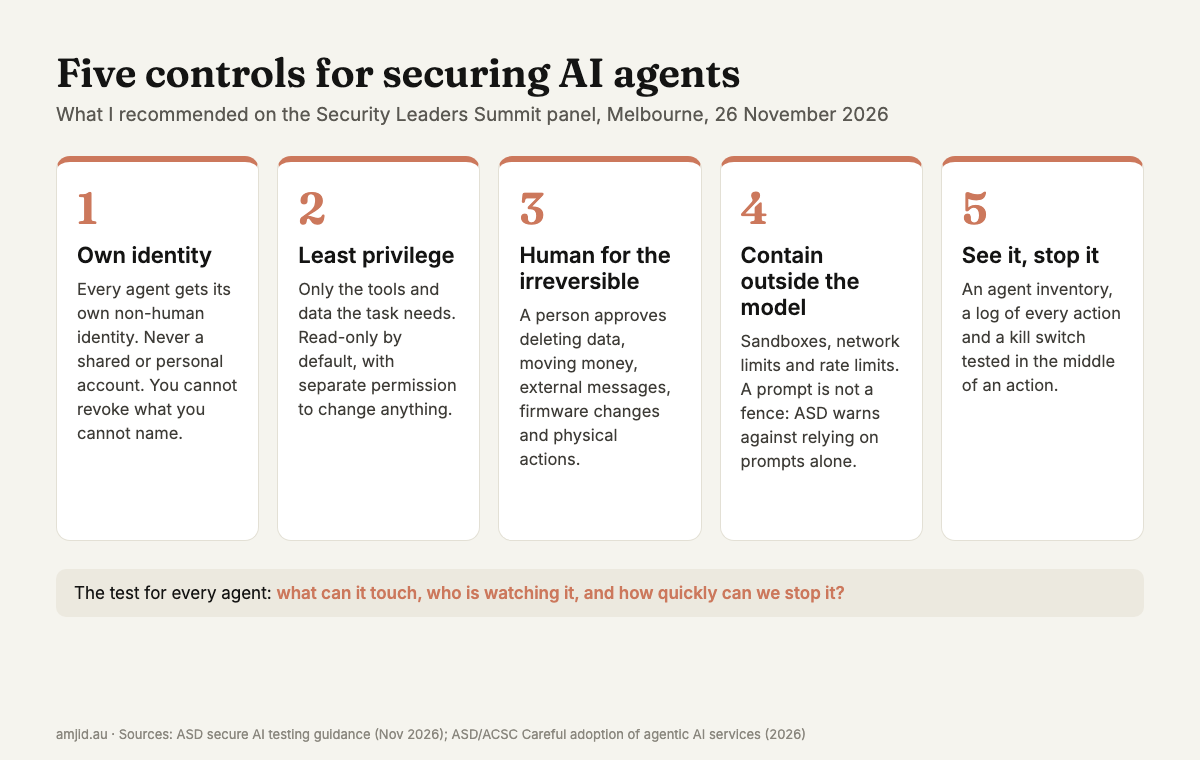
| Control | What it means | Why |
|---|---|---|
| 1. Own identity | Every agent has its own non-human identity, never a shared or personal account | You cannot revoke what you cannot name |
| 2. Least privilege | Only the tools and data the task needs; read-only by default | Limits the blast radius when it goes wrong |
| 3. Human for the irreversible | A person approves deletions, payments, external messages, firmware and physical actions | Some mistakes cannot be undone |
| 4. Contain outside the model | Sandboxes, network limits and rate limits | A prompt is not a fence |
| 5. See it, stop it | An agent inventory, a log of every action, a kill switch tested mid-action | You need to stop it in seconds, not days |
These come from building agents in production, not from theory. Before we build anything, we classify each process as deterministic, probabilistic or needing a human, and many need no AI at all. No agent goes live until it has passed a graduation bar on real cases, and approvals and segregation of duties always stay with people. The AI agent security controls guide goes deeper on each control.
What should Australian leaders do on Monday?
- List every AI agent you run and what it can touch, including the ones built into the SaaS tools you already pay for.
- Give each agent a named human owner and its own identity.
- Test your kill switch while an agent is in the middle of a task.
- Run one joint exercise with security, facilities, procurement and the business in the room: a supplier’s remote access is abused and an agent starts taking actions nobody approved.
My closing line on the panel was this: find out what your AI agents can actually do, not what they are meant to do. Give every agent a name, a leash and an off switch.
If you would like me to speak on securing AI agents or agentic AI security at your event, see my speaking page.