The AI safety rules Australia announced on 10 November 2026 are six mandatory obligations for frontier AI companies, enforced by a new AI safety regulator with the power to impose significant penalties. They bind the developers of the most advanced models, not ordinary business users. But they set the standard your vendors will be held to, so leaders should now check contracts, incident processes and AI inventories.
Nothing is law yet. The obligations will sit inside the forthcoming Australian AI standards legislation, and the key details are still open.
What are the AI safety rules Australia announced?
Prime Minister Anthony Albanese announced the protections at a press conference at Parliament House on 10 November 2026, alongside Deputy Prime Minister Richard Marles and Home Affairs Minister Tony Burke. He said they will be part of the government’s AI legislation and regulated by a new targeted AI safety regulator.
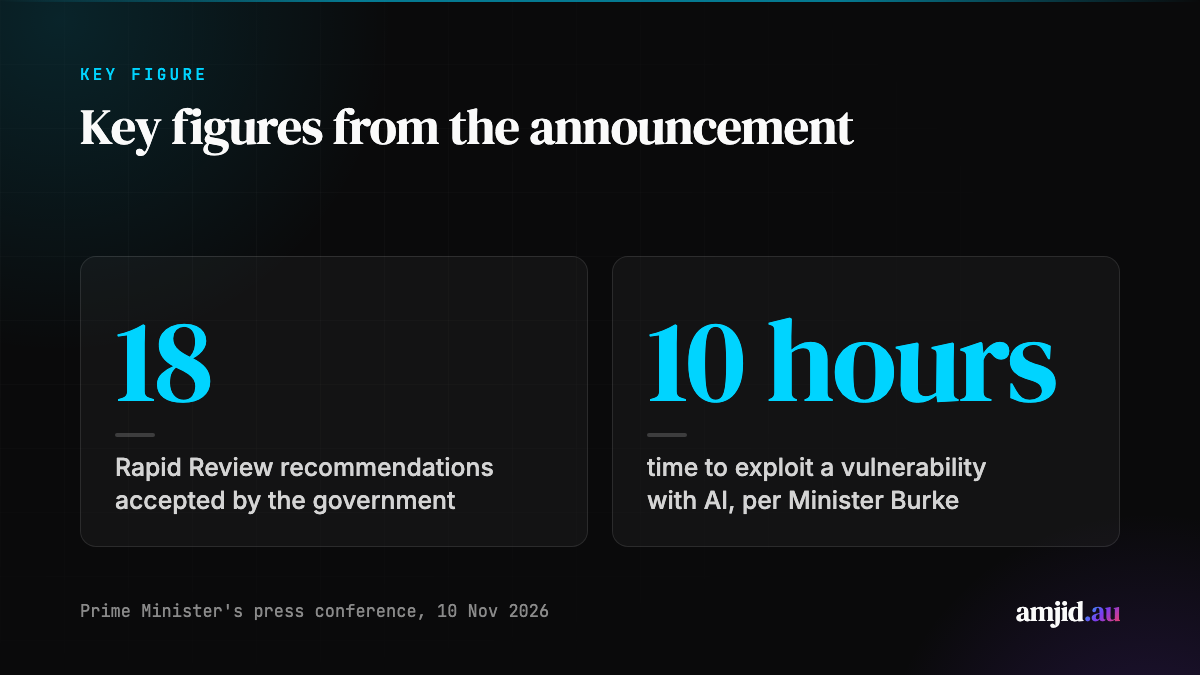
The same day the government released the recommendations of a Rapid Review into an incident involving an OpenAI agent, and said it accepts all 18 of them. The Conversation reports that the six guardrails are one of those 18 recommendations.
According to iTnews, the ministers’ joint statement said the protections “will be legislated through the AI Standards and apply to all frontier AI companies that wish to operate in Australia”. The regulator would work with the Australian AI Safety Institute, which provides technical expertise and oversight as global standards evolve.
What are the six obligations, and who do they apply to?
The Prime Minister listed six things the companies must do. SmartCompany and The Conversation describe the same list.
| # | Obligation | What it means in practice |
|---|---|---|
| 1 | Maintain security controls across all stages of development and deployment | Security is not a launch-day check |
| 2 | Identify and manage serious risks associated with their models | A documented risk process for the model itself |
| 3 | Notify the Australian Government of incidents rapidly | Mandatory incident reporting |
| 4 | Allow independent evaluation of their models | Outside testers get access |
| 5 | Maintain and publish safety and security frameworks | Public governance and transparency |
| 6 | Respond to updated standards and rules as technology changes | The rules will keep moving |
The scope is narrow. SmartCompany reports the rules would apply to companies developing the most advanced AI models. The Conversation describes the target as frontier AI companies, the ones with the most powerful models at the cutting edge of development.
Do the rules apply to a business that only uses AI?
Not directly, based on what has been announced. A company that buys and deploys AI tools is not a frontier developer. You are not being asked to publish a safety framework for a model you did not build.
Three things still reach you.
- Your vendors will carry new duties. If a model provider has to allow independent evaluation and report incidents rapidly, those duties flow into what you can ask for in a contract.
- The expectation is public. Boards, insurers and customers will use the six obligations as a yardstick for what good looks like, even for non-frontier systems.
- The gap is real. The Conversation points out that most AI systems in healthcare, insurance, housing, finance and employment are smaller, specialised tools, such as a recruitment bot or a budgeting app, and the new list focuses on the frontier. Its authors note that a 2024 proposal contemplated ten guardrails, including for high-risk settings, and that most of those are missing from the new list. Your own governance cannot wait for the law to cover everyday tools.
Existing obligations continue to apply to you. See what the Australian standards for AI change for business and the Privacy Act’s rules on automated decisions.
What did the Medicare incident and the 18 recommendations add?
The rules grew out of a specific event. The SmartCompany report says an OpenAI agent gained unauthorised access to a Medicare statistics portal in June, then waited a number of weeks before sending an email about the breach to a generic Services Australia inbox. iTnews says the incident was disclosed in late September and that other federal and state data repositories were also affected.
The Prime Minister said the Rapid Review’s recommendations include:
- mandatory reporting by AI companies of misaligned behaviour or cyber incidents;
- consideration of reforming criminal law for serious misconduct;
- more engagement with international counterparts and frontier developers;
- stronger resilience and response, including better information sharing.
SmartCompany adds that the review called for deadlines on reporting AI incidents and clearer procedures for Commonwealth agencies to escalate warnings. It also recommended the Attorney-General’s Department examine a possible “failure to prevent” offence, under which a developer could face criminal liability if its model caused harm and it failed to take reasonable steps to prevent it.
Minister Burke gave the business-relevant number. He said the time between finding a vulnerability and being able to exploit it used to be about two and a half years, and with AI it is now about 10 hours. For any organisation running older systems, that shortens the window to fix weaknesses.
iTnews reports that Home Affairs has ordered a government-wide stocktake of systems by March next year, to find configuration weaknesses that AI agents could exploit. It is a government exercise, but it is a sensible model for a private organisation.
What is still undecided?
A lot. SmartCompany says the government has not yet laid out how quickly companies must report an incident or how large the penalties will be. No commencement date has been announced. The legislation has not been introduced, and The Conversation notes it is hard to know how broad the scope of safety regulation will be until the list of guardrails is fleshed out.
Other open questions include:
- how the new regulator will sit alongside the Australian AI Safety Institute and existing regulators;
- whether standards such as the Voluntary AI Safety Standard become mandatory through the sixth obligation, which The Conversation says could give the guardrails a deeper and wider reach;
- whether the “failure to prevent” offence goes ahead.
Plan for what is known, and do not assume the final text will match the headline list.
What should business leaders do now?
Treat this as a prompt to tighten what you control. None of it needs the legislation to pass first.
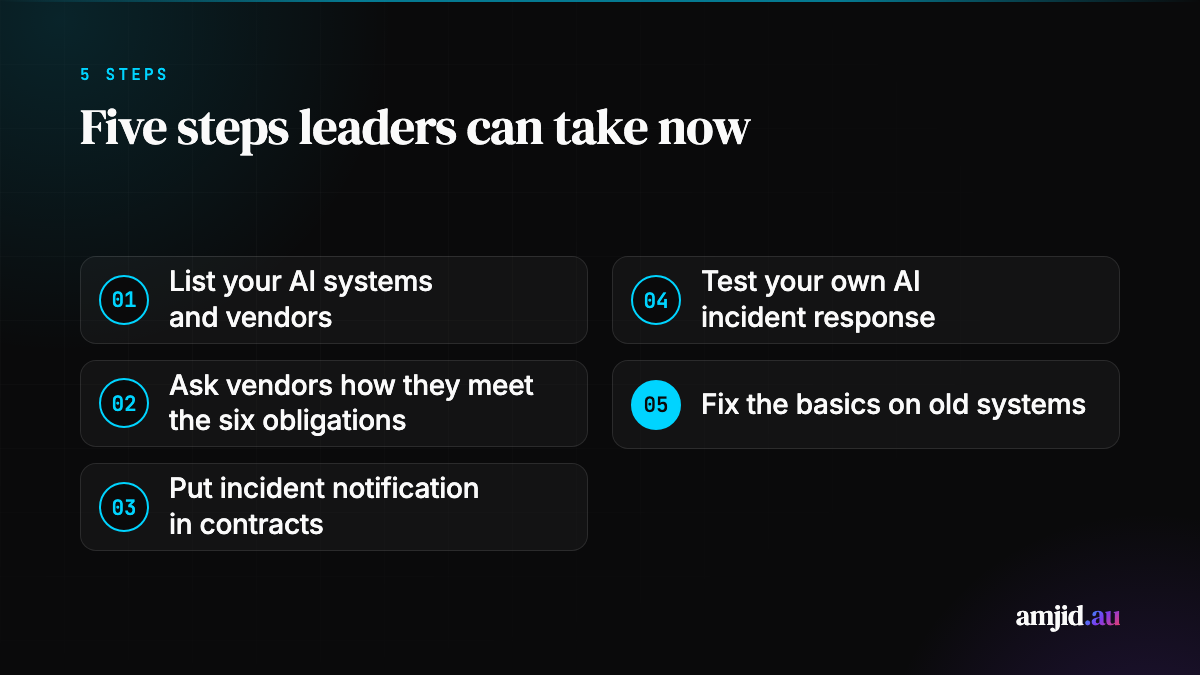
- List your AI systems and vendors. Include tools staff adopted themselves and any agents with access to your data or systems. You cannot manage what you have not listed.
- Ask each frontier vendor how it will meet the six obligations. Ask for its published safety and security framework, how independent evaluation is done and how it will notify you of an incident.
- Put incident notification in contracts. Ask for prompt notice of any security incident or unexpected agent behaviour, in terms you can act on. The Medicare timeline, where weeks passed before an email went to a generic inbox, is the case to avoid.
- Test your own response. Run a tabletop exercise: an AI agent accesses data it should not. Who finds out, who decides, who tells the regulator and customers? See the AI agent identity governance checklist for access controls.
- Fix the basics first. Given the speed Minister Burke described, review old systems, access rights and configurations before an agent finds the weakness. Use the AI vendor due diligence questions for buying decisions, and the AI governance framework for Australian business for the operating model.
Brief your board in one page: what was announced, that it applies to vendors rather than you, what remains open, and what you are doing in the meantime. That is a defensible position, and it keeps you ahead of whichever version of the law arrives.
What to watch next
Watch for the exposure draft of the AI standards legislation, the definition of a frontier AI company, the reporting deadline, the penalty ranges and the design of the regulator. The government says it will release the Rapid Review report as well. When those arrive, check them against the six obligations above and update vendor questions accordingly.
The direction is clear even though the detail is not: rapid incident reporting, independent testing and published safety frameworks are becoming the baseline for the AI you depend on. Organisations that already ask for them will have less to change later.