AI agent identity governance means treating an agent that can use business tools as a controlled participant in a workflow, not as an anonymous feature of a software subscription. For Australian leaders, the practical response is to give every agent a distinct identity, a named accountable owner, minimum access and a documented approval boundary before it is allowed to act.
This post contains affiliate links: if you buy through them, SyncBricks may earn a commission at no extra cost to you.
That is a business control as much as a security control. An agent can draft an email, check stock, book an appointment or move through a multi-step process. The National AI Centre says agents differ from other AI systems because they interact with systems and tools. If nobody can identify which agent did what, on whose authority and with which permissions, a team cannot reliably investigate, pause or improve the workflow.
What is AI agent identity governance?
AI agent identity governance is the operating discipline that connects an agent to a purpose, owner, permissions and evidence trail. It answers five direct questions:
- What job is this agent approved to perform?
- Which business owner is accountable for that job and its outcomes?
- Which systems, data and tools may it use?
- What actions require human approval or must never be taken?
- Where are the records needed to review its activity, changes and incidents?
This is not a claim that every agent needs a particular identity product or technical standard. It is a leadership checklist for making authority visible. The Australian Government’s implementation guidance calls for clear roles, AI registers and records of governance decisions, testing, incidents and monitoring. It also says organisations remain ultimately accountable for how and where AI is used.
An identity is the thread that joins those obligations. Give an agent its own account or service identity rather than lending it a staff member’s credentials. Link that identity to a specific use case and owner. Then a permission can be granted, reviewed and revoked for the agent without creating uncertainty about who used a system.
Why does AI agent identity governance need a distinct control model?
A conventional software user normally acts through a person’s account. An agent may initiate work, select tools, call services and hand work to another system at speed. Its authority can also change materially when a new connector, model, prompt, dataset or tool is added.
The important distinction is between an agent that assists and an agent that acts. A drafting assistant with no access to a business system has a narrower authority boundary than an agent that can alter a customer record, send an external message or place an order. The latter needs a clear identity, least-privilege access and an intervention path before launch.
The Australian AI Safety Institute’s August 2026 guidance adds another reason for care: controls that are effective for one agent may not be sufficient once agents interact. When a business agent deals with a supplier, customer or anonymous service, no single organisation necessarily governs the whole exchange. The guidance advises organisations to agree safeguards, monitoring and escalation points in shared environments, and to limit what an agent can access in open environments.
Privacy belongs in the same discussion. The OAIC defines personal information as information or an opinion about an identified individual, or an individual who is reasonably identifiable. Leaders should therefore map whether an agent can read, create, disclose or route such information before access is approved. The question is not only whether the model is capable. It is whether the workflow gives it a legitimate, bounded reason to reach that data.
The Australian leader’s checklist for AI agent identity governance
Use this checklist before an agent is connected to a production tool, and again whenever its role changes.
| Control | Decision to document | Evidence to retain |
|---|---|---|
| Purpose | The workflow, intended outcome and prohibited uses | Approved use-case statement |
| Accountable owner | The business owner, technical owner and escalation contact | Named roles and authority |
| Distinct identity | The account or service identity used by the agent | Identity record and environment |
| Minimum access | Systems, data and tools required for the approved job | Permission inventory and review date |
| Action boundary | What it may draft, recommend or execute | Approval and stop rules |
| Monitoring | What activity, exceptions and changes will be reviewed | Logs, alerts and review cadence |
| Lifecycle control | Who approves changes, suspension and retirement | Test records, change history and exit plan |
1. Name the business outcome. Define the trigger, expected result, exception route and the boundary of the workflow. The National AI Centre advises organisations to document intended use cases, capabilities, limitations, expected context and foreseeable misuse for each system. A vague purpose such as “help operations” cannot support a defensible access decision.
2. Assign accountability before access. Record the business person accountable for the outcome, the person responsible for the technical operation, and the contact who can stop the agent. The implementation guidance recommends that organisations assign, document and communicate accountability for the development and deployment of every AI system, including ongoing human control and oversight.
3. Issue a distinct, purpose-bound identity. Do not make the agent indistinguishable from an employee or a shared integration. Its identity should point to the approved workflow and environment. That makes access review and incident investigation practical, and makes it possible to withdraw the agent without disrupting unrelated work.
4. Grant the minimum practical permissions. Start with only the tools, data and actions required for the first bounded use case. Separate read access from the ability to change a record or communicate outside the organisation. A new connector is not a minor configuration detail. It is a change in authority that deserves review.
5. Put human approval at meaningful decision points. State whether the agent may prepare, recommend or execute. For consequential actions, require a human approval, a threshold or a stop condition. The government guidance describes the need for ongoing human control and oversight; it should be designed into the workflow rather than improvised after an incident.
6. Record activity that matters. Retain enough evidence to reconstruct the workflow: which identity ran, which tools it used, what approval was obtained, what changed and what exception occurred. The National AI Centre calls for clear records of governance decisions, testing, incidents and monitoring. Avoid collecting records merely because they are available; choose records that support accountability and investigation.
7. Review the agent throughout its lifecycle. Set a review date and reassess after a material change in tools, data, permissions, model behaviour, suppliers or operating environment. NIST’s AI Risk Management Framework is voluntary guidance intended to help organisations incorporate trustworthiness considerations into the design, development, use and evaluation of AI systems. The practical lesson is to make identity and access review continuous, not a one-time procurement gate.
How should leaders put the checklist into operation?
Begin with one workflow where the agent’s authority can be described in a page. A useful first pilot may prepare a draft for a staff member who remains responsible for the decision. Avoid beginning with an agent that can take broad action across finance, customer or supplier systems.
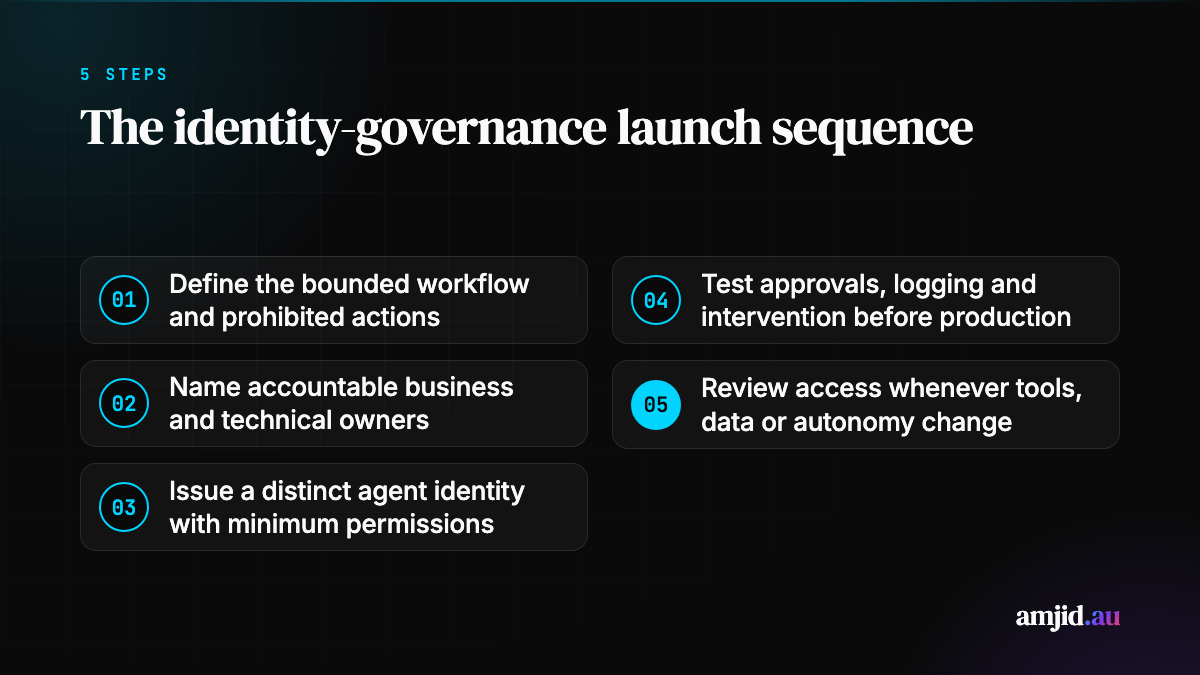
First, create an entry in the AI register. Capture the purpose, owner, systems, data categories, supplier dependencies, identity, permissions and review date. Second, have the process owner and technology owner agree the approval boundary. Third, test the agent with the minimum access in a controlled environment. Finally, move to production only when the organisation can see its activity, intervene and explain the decision to grant access.
For a leadership view of how automation choices fit organisational change, Digital Transformation 101: Strategy, Automation, and AI to Lead in the Digital Age is Amjid Ali’s book on connecting technology decisions to operating practice.
The register should also identify third parties. The implementation guidance says organisations should document accountability across the AI supply chain, including third-party providers and systems. For a supplier-hosted agent, that means recording what the supplier operates, what your organisation controls, how incidents are escalated and how access can be withdrawn.
Recent enterprise announcements also illustrate why a durable evidence trail matters. In an October 2026 report, VAST and Nvidia described an architecture designed to retain records of tool calls, prompts, tokens, costs and decisions after short-lived agents have ended. That is a vendor claim about its own stack, not a universal requirement, but it usefully sharpens the buying question: can the proposed environment retain enough evidence to understand an agent’s work after the fact?
What should be reviewed before an agent is given a new tool?
Treat a new tool as a proposal to expand the agent’s authority. Ask whether the tool is necessary for the approved purpose, what data it exposes, whether it can cause an external effect, and how a human can reverse or contain an error. Update the register, permission inventory and test evidence before enabling it.
The same discipline applies when agents interact beyond the organisation. The National AI Centre recommends evaluating internally connected agents together as a system. Where separate organisations’ agents interact, agree rules and protocols in advance. Where an agent encounters anonymous services on the open web, assume it could be attacked, manipulated or incompatible, and constrain its access accordingly.
A 9 October 2026 SmartCompany report highlighted the commercial counterpart to this control problem: Australian legal experts advised businesses to restrict what customer-facing agents can discuss, control their information access and test them continuously as underlying models change. The applicable liability in any case depends on its facts and contracts, but leaders should not treat a third-party platform as a transfer of their own operational responsibility.
Existing guidance on AI agent security controls can help teams translate those boundaries into practical safeguards. Before selecting a supplier or expanding a platform, use the questions in this AI vendor due diligence checklist to examine accountability, access and operational support.
For teams building the workflow skills behind a controlled pilot, AI Automation Mastery: Build Intelligent Agents with LowCode is Amjid Ali’s practical course. It is training for implementation, not a substitute for security, privacy or governance review.
The decision leaders should make now
Do not wait for an autonomous agent to make a consequential error before asking who it is, what it may access and who can stop it. Make those answers a condition of production access. A discrete identity, a named owner, minimum permissions, a human approval boundary and usable records are modest requirements compared with the operational uncertainty they remove.
Australia’s voluntary AI guidance is designed to help organisations strengthen accountability, risk management, testing, monitoring and supply-chain controls as their use grows. Identity governance gives those governance decisions a working home at the point where an agent meets a business system. Start with one bounded workflow, make its authority legible, and require every expansion of that authority to earn approval.