AI agent cost in Australia is best treated as a budget design problem, not a number on a supplier quote. Fund the work to define and integrate the agent, then fund the controls, model and tool use, monitoring and people needed to operate it. Start with one bounded workflow and a measurable outcome before approving a broader rollout.
This post contains affiliate links: if you buy through them, SyncBricks may earn a commission at no extra cost to you.
That distinction matters because an agent does more than generate an answer. It can move through a process, call tools and interact with business systems. The August 2026 guidance from the National AI Centre describes agents being used by Australian organisations to complete tasks, book appointments, check stock and draft emails. The budget therefore needs to cover the operating model around the software, not just the software itself.
What does an AI agent cost in Australia?
The honest answer is that the cost is specific to the job, not the label. An internal agent that prepares a draft for a staff member has a very different cost profile from one that reads operational data, takes actions in several systems and works outside business hours.
Avoid budgeting from a generic market price range. It makes a business case look precise while hiding the decisions that actually drive spend. Instead, ask what the agent may do, what systems and data it may reach, who checks its work, and how its performance will be measured.
Australian leaders should also resist treating this as a niche engineering decision. The National AI Centre’s April 2026 ecosystem update identified a sample of 1,533 AI companies, with 85% of the private companies in that sample employing fewer than 50 staff. Australia is primarily applying AI to existing processes, the report says. That makes disciplined buying and operating practices important for organisations of every size.
A useful starting point is a budget with two horizons:
| Horizon | What to fund | Decision it supports |
|---|---|---|
| Initial delivery | process definition, design, integration, access controls, testing and training | whether the use case is safe and practical to launch |
| Ongoing operation | model and tool use, monitoring, support, governance, change management and review | whether the agent should continue, expand or stop |
This approach does not promise a saving before there is evidence. It makes the assumptions visible so a CFO, CIO and process owner can agree on what must be true for the investment to continue.
Why a single build quote is not an AI agent budget
A build quote may be a valid input. It is not the budget. It normally says little about the process work needed before configuration, the controls required before access is granted, or the effort to keep the agent reliable after launch.
The National AI Centre’s implementation guidance is clear that the organisation remains accountable for how and where it uses AI. It asks organisations to document responsibilities across the AI supply chain, including third-party providers, and to provide sufficient human effort and compute across the lifecycle. Those are operating costs, whether they sit with an internal team or a supplier.
The cost shape also changes with autonomy. An agent that drafts a response for staff review can be piloted with narrow permissions. An agent that triggers an order, changes a record or engages a supplier needs more design around approvals, identities, logging and exception handling. If it interacts with systems operated by another organisation, the governance burden increases again.
The National AI Centre’s August guidance on multi-agent systems makes this point directly: controls that work for an individual agent may not be enough once agents interact. For an agent working in an open environment, the guidance recommends limiting what it can access and assuming it may be attacked, manipulated or incompatible with other services. These are not optional add-ons to cost later. They belong in the original scope.
The five cost lines leaders should fund
A practical budget has five lines. The exact split will differ, but leaving any line out creates an avoidable surprise.
1. Discovery and process design
Fund the work to choose a narrow, valuable workflow and define what a successful completion looks like. Map the inputs, decisions, exceptions, hand-offs and the person who can intervene. This is where teams decide whether an agent should recommend, prepare or act.
The output should be a statement a business owner can approve: what the agent is allowed to do, what it must not do, when it pauses, and how a human takes over. This is also the point to establish a baseline for the current process. Without it, the organisation cannot later assess whether the agent improved the outcome.
2. Integration, data and controls
Fund connections to the systems the agent needs, but only to the minimum data and permissions required. Include identity and access design, audit records, security review, test environments and a rollback path.
The government foundations guidance recommends an AI register covering systems the organisation uses, including AI embedded in other products. It also recommends extending data governance and cyber security practices to AI systems. That work is often missed when a team begins with a demonstration rather than an operating design.
For further reading on the wider leadership work behind these decisions, Digital Transformation 101: Strategy, Automation, and AI to Lead in the Digital Age is Amjid Ali’s book on connecting technology choices to organisational change.
3. Model, tool and infrastructure use
This is the variable consumption line: the model calls, tool calls, data retrieval, storage and any hosting or integration services needed for the workflow. It should be measured against a unit of business work, such as a completed request or reviewed document, rather than treated as an undifferentiated technology bill.
Specify what will be recorded for each run: the workflow, the tools used, the approvals sought, the result and the consumption attributable to it. That is increasingly an architectural requirement. In an October 2026 report on an enterprise agent sandbox, VAST and Nvidia described retaining records of agent prompts, tool calls, tokens, costs and decisions. Regardless of platform, leaders should ask whether their design can explain what the agent did and what it consumed.
4. Testing, monitoring and incident response
Fund testing before launch and after material changes to prompts, tools, models, data or permissions. Budget for monitoring, escalation and the staff time to investigate unexpected behaviour.
The National AI Centre advises organisations to test a system before deployment, monitor it after deployment and match monitoring to the assessed risk. Its implementation guidance also calls for records of governance decisions, testing, incidents and monitoring. An agent with no owner watching its real-world behaviour is not a low-cost deployment. It is an unpriced risk.
5. People, governance and change
Fund a named accountable owner, process expertise, training for users and overseers, supplier management and periodic review. Human oversight needs to match the stakes and autonomy of the use case. The foundations guidance recommends clear intervention points where people can pause, override, roll back or shut down AI systems.
This is particularly important when the workflow crosses organisational boundaries. The August multi-agent guidance recommends agreeing safeguards, monitoring and escalation points before agents from different organisations operate across shared environments. Recent Australian reporting also highlights the commercial consequence of loose authority boundaries when agents communicate or transact externally.
How to build an AI agent budget before procurement
Use this sequence before comparing vendors or approving a proof of concept.
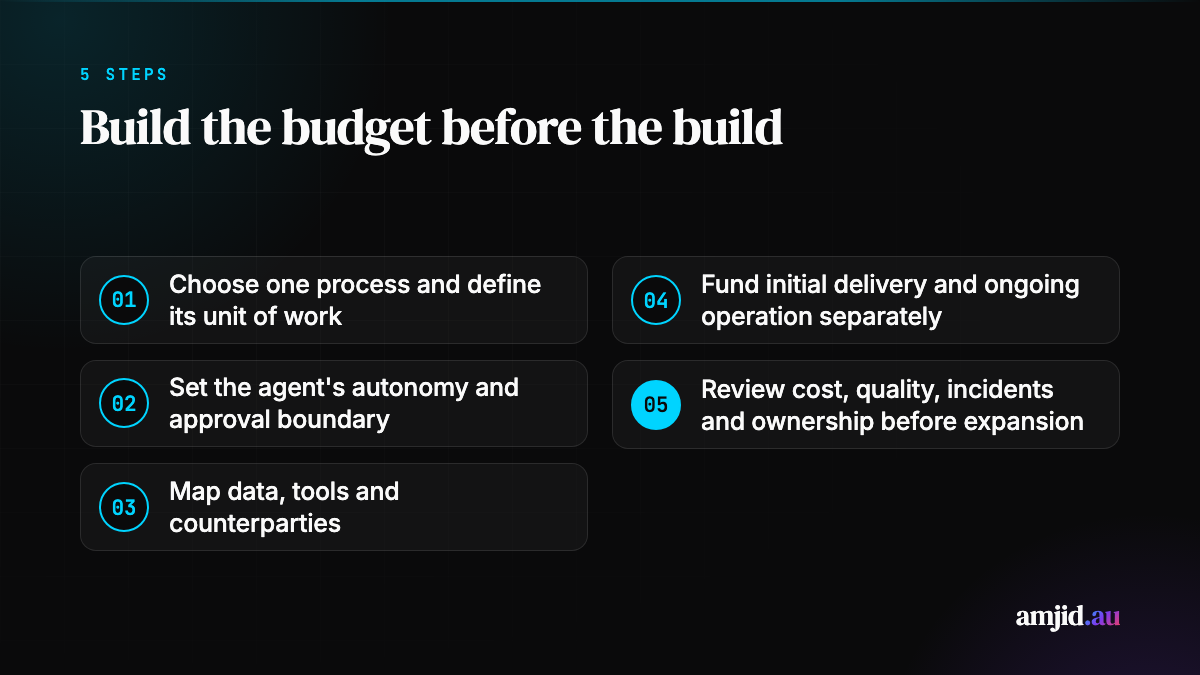
- Choose one process and define the unit of work. Describe the trigger, completion condition, exception route and human owner. Do not begin with a request to “build an agent”.
- Set the autonomy boundary. State whether the agent drafts, recommends or acts. List every action requiring approval and the conditions that force a stop.
- Map data, tools and counterparties. Identify systems, permissions, sensitive information and any supplier or customer environment the agent will touch.
- Create the two-horizon budget. Cost initial delivery separately from ongoing operation. Assign an internal owner for each of the five cost lines, even when a vendor performs the work.
- Define the evidence for continuation. Set measures for completion quality, exceptions, human interventions, usage and cost per unit of work. Review them on a set cadence.
- Run a controlled pilot. Use limited permissions and real monitoring. Expand scope only after the agreed evidence is available.
This is consistent with the government’s advice to assess each use case in context, document risks and keep systems under meaningful human control. It also helps procurement ask better questions: what is included in the initial scope, what changes the recurring bill, where are the logs, and who can intervene?
Teams wanting hands-on practice with workflow design can use AI Automation Mastery: Build Intelligent Agents with LowCode, Amjid Ali’s course on building intelligent agents with low-code tools. Treat it as practical training, not a substitute for governance and security review.
What governance changes the cost of an AI agent?
Governance changes cost because it changes the work required to deploy safely. The higher the autonomy, sensitivity and external connectivity, the more the organisation needs clear accountability, testing, records and intervention paths.
That is not a reason to avoid useful automation. It is a reason to match the first use case to the organisation’s maturity. An internal, bounded workflow with a human reviewer may be a sensible place to learn. A multi-system agent acting on customer, supplier or financial data needs a more complete operating model from day one.
Two existing guides can help frame that work. AI vendor due diligence sets out the questions to ask before buying. AI agent security controls covers the controls that should accompany access to tools and data. Leaders can also use the AI governance framework for Australian business to align roles, registers and review processes.
A decision rule for moving from pilot to production
Move forward when the agent has demonstrated a useful, repeatable outcome within its defined boundary and the organisation can explain its cost, controls and ownership. Pause when the workflow cannot be measured, permissions are broader than necessary, exceptions are unresolved or no one is accountable for intervention.
The budget conversation should then become routine. Review the operating cost against the agreed unit of work, review quality and incidents, and decide whether to maintain, improve, expand or retire the workflow. This is more useful than defending a headline figure because it gives leaders a way to govern the actual system they are buying.
An AI agent budget in Australia should therefore be an operating commitment, not a one-off technology purchase. Start small, document the whole cost of running the workflow and make expansion earn its place through evidence.