AI agent ROI in Australia should be measured as a change in a defined business workflow, not as a claim about hours saved or a dashboard of model usage. Establish the baseline, capture the full operating cost, test whether the agent improves a business outcome without lowering quality or control, and give finance a regular role in the decision to continue, change or scale.
That discipline is timely. Research reported in November 2026 found that only 43% of organisations in Australia and New Zealand use ROI and business-value targets to assess AI progress. The same research found 66% had not formally calculated AI’s financial return and had it reviewed by finance or senior leadership. The problem is not a shortage of activity. It is a shortage of evidence leaders can use to allocate capital.
Why AI agent ROI is a measurement problem
An agent differs from a general-purpose assistant because it can carry work through a process: retrieving information, applying rules, calling tools, preparing an outcome and sometimes taking an action. A useful ROI measure must therefore cover the workflow around the model, not only its prompt or token consumption.
Start by rejecting two weak proxies:
- Activity is not value. A count of pilots, licences or conversations says little about whether work improved.
- Time saved is not automatically a financial return. Time has value only if the organisation can redeploy it, avoid additional work, improve service or remove a cost. Record the assumption rather than converting every minute into a saving.
The gap is visible in recent research. In the Australia and New Zealand findings reported by IT Brief, 68% said AI had not yet delivered financial returns that justified the spending. Separately, Microsoft published IDC research in November 2026 showing 66% of leaders reported substantial or transformative AI results, while only 48% were scaling that value across multiple business units. These are survey findings, not a promise of returns for a particular organisation. They do show why a repeatable measurement method matters before an agent gains wider access.
What should leaders measure before an AI agent goes live?
Define one unit of work that the process owner recognises. It might be a completed supplier enquiry, a triaged service request, a reconciled exception or a document prepared for review. Write down the start trigger, completion condition, hand-offs and exceptions.
Then record a baseline over a representative period. The baseline should include volume, elapsed time, quality or error rate, rework, escalations and the people involved. If a number cannot be captured reliably, label it as a hypothesis rather than using it in the investment case.
Use a balanced scorecard. Cost matters, but it cannot sit alone when an agent may affect customer experience, compliance or operational risk.
| Measurement area | Baseline question | Evidence after launch |
|---|---|---|
| Outcome | What completed business result matters? | Completed work that meets the agreed definition |
| Quality | What makes the result acceptable? | Review results, corrections, rework and escalations |
| Speed | How long does the workflow take now? | Cycle time from trigger to accepted completion |
| Cost | What does the workflow cost to operate? | Full agent and human operating cost per unit of work |
| Control | What can go wrong and who intervenes? | Exceptions, overrides, incidents and audit records |
This approach also makes the decision clearer for a CFO. A reduction in cycle time may be valuable even when it does not remove a role. It may reduce backlog, improve cash collection, avoid a service breach or release skilled staff for higher-value work. The business owner should state which of those outcomes is expected and how it will be verified.
A five-part AI agent ROI framework for Australian organisations
The framework below keeps financial measurement connected to quality and control. It can be used for a contained pilot or a production workflow.
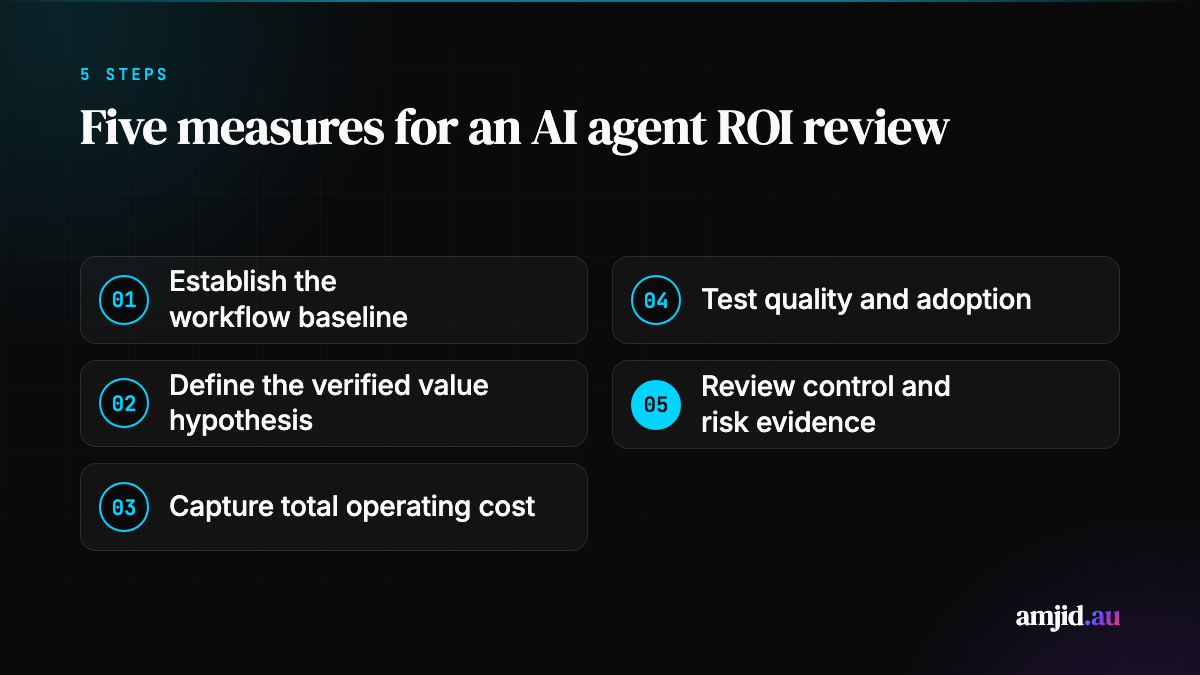
1. Establish the baseline
Measure the current workflow before changing it. Avoid comparing an agent’s best demonstration with a rushed or incomplete picture of the current process. The baseline is the reference point for every later claim.
2. Define the value hypothesis
Choose the primary outcome: lower rework, faster resolution, higher conversion, fewer avoidable contacts or a better compliance outcome. Define the causal path. For example, a faster first response matters only if it increases accepted completion or reduces costly follow-up.
Keep secondary benefits separate. They may be real, but should not be counted twice in the same business case.
3. Capture total operating cost
Include design and process work, integration, access controls, data preparation, model and tool use, monitoring, support, training and the human time used to review exceptions. Divide recurring cost by the same unit of work used in the baseline.
For related guidance on making those cost lines visible, see the AI agent cost framework for Australian leaders.
4. Test quality and adoption
Track whether staff use the agent in the intended workflow and whether its outputs are accepted without hidden rework. A lower apparent unit cost is not a gain if reviewers spend more time correcting results or routing exceptions elsewhere.
Microsoft’s November 2026 post, based on IDC research it commissioned, reported that 61% of organisations were highly confident they could measure AI business value and ROI. The same post says the survey covered more than 5,200 senior IT and business leaders across 28 industries. Treat that as a broad benchmark, not an Australian market result or an independent product comparison.
5. Review control and risk evidence
Record what the agent did, which tools it used, when a human intervened and whether an incident or policy exception occurred. The Australian Government’s AI guidance is directed to government agencies, not private organisations. Its underlying practices are still useful reference points: assess risks and impacts, maintain oversight of use cases, meet accountability requirements and build organisational capability.
An organisation cannot make a sound ROI decision if it cannot explain the operational conditions that produced the number.
How do you calculate AI agent ROI without overstating it?
Use a calculation that is simple enough to audit:
Net value = verified benefits − total operating cost
ROI = net value ÷ total operating cost
The equation is straightforward. The work is in defining “verified”. For each benefit, document the baseline, the post-launch result, the method of attribution, the owner and the period measured. Do not treat a forecast as a realised benefit.
A practical sequence is:
- Agree the unit of work and baseline with the process owner.
- Set a short list of outcome, quality, cost and control measures before launch.
- Run the agent within a bounded permission set and retain evidence of exceptions and interventions.
- Ask finance to validate the conversion of operational measures into financial value.
- Compare the evidence with a pre-agreed decision threshold.
Where an agent supports rather than replaces staff, report capacity separately from cashable savings. For example, “the team completed more accepted requests with the same roster” is a defensible operating result. Calling that result a dollar saving requires evidence that spending, overtime, external fees or a future hiring requirement actually changed.
What should be in a monthly AI agent scorecard?
The scorecard should fit on one page and answer three questions: is the workflow producing its intended outcome, what is it costing, and is it staying within its approved boundary?
Include:
- volume of eligible and completed units of work
- outcome measure against the baseline
- accepted-output rate, rework and escalation rate
- median cycle time
- full cost per completed unit, including human review where material
- adoption by the intended team or workflow
- exceptions, overrides, access changes and incidents
- the decision: maintain, improve, expand, pause or retire
Name the owners. The process leader owns whether the outcome matters. Finance owns the integrity of the financial view. Technology and security own the operating evidence in their domains. One accountable executive should decide whether the agent moves beyond its approved scope.
The National AI Centre says it provides guidance, tools and planning resources to help Australian businesses use AI safely. Its practical framing is helpful here: value work should not be separated from the planning, policy, training and responsible-use work that makes a system operable.
When should an organisation scale, change or stop an agent?
Scale when the results are repeatable, not merely impressive in a single demonstration. The agent should meet its outcome and quality thresholds, have a stable cost per completed unit, and show that its exception and intervention paths work in practice.
Change the workflow when the value hypothesis is plausible but the evidence reveals a bottleneck: poor input data, too many exception types, unclear human ownership or an autonomy level that is too high. Reducing scope can be a better outcome than adding a larger model or more tools.
Stop when the workflow has no measurable baseline, quality declines, controls cannot be demonstrated, or the cost to operate is greater than the verified value. Stopping a weak use case is evidence of a working governance process, not a failure to adopt AI.
For the control questions that sit beside an ROI review, use the AI agent identity governance checklist and the AI agent security controls guide. The aim is not a perfect forecast. It is a decision record that shows what changed in the business process, what it cost, and what evidence supports the next investment decision.