The Fair Work Commission AI disclosure rules require an employer that uses generative AI to prepare a document in a Commission case to disclose that use, explain how AI assisted, verify the material itself and state that the checks were completed. They apply to all Commission cases and are a filing and evidence discipline, not a general obligation to disclose every workplace use of AI. For employers, the immediate task is to make human review, confidentiality controls and a clear record of AI use part of the case-document workflow.
The Commission published practical guidance on 23 October 2026 after its new requirements came into effect in mid-October. This is general information, not legal advice. The right response to a live matter depends on its facts and legal advice.
What are the Fair Work Commission AI disclosure rules?
The Fair Work Commission’s guidance concerns generative AI used to create, write, edit or otherwise prepare documents for a Commission case. It gives familiar tools such as ChatGPT, Claude, Copilot and Gemini as examples.
If AI was used, the party must do three things:
- Tell the Commission that generative AI was used and explain how.
- Personally check that the document is accurate, relevant and supported by real evidence and legal authorities.
- State in the document that those checks have been completed.
The important distinction is between assistance and responsibility. AI may help organise facts, transcribe speech, translate text, draft content or edit a document. It does not become the source of facts, legal research or evidence. The person filing remains responsible for what is put before the Commission.
The Commission’s page also makes clear that generative AI is not a substitute for legal advice. An organisation should not present an AI output as though it had independently verified the authorities, the evidence or the legal position.
Which documents and people do the rules cover?
The requirements apply across Commission cases. The Commission expressly identifies applications, submissions, witness statements and other documents. They are therefore relevant to an employer responding to an unfair dismissal, general protections or other Commission matter, as well as to an applicant.
Witness evidence needs an additional check. A witness or declarant must ensure an AI-assisted statement is based on their own knowledge, reflects their own words and is true to the best of their knowledge. That is a practical reason not to treat a polished AI draft as ready to sign. The witness needs time to read it, correct it and confirm it personally.
Legal practitioners and other professional representatives must also include hyperlinks to case law referred to in documents prepared using AI. This supports a simple operating principle for internal teams: every cited authority needs a source that a human has opened and checked.
The wider operating context matters. In its October 2026 change update, the Commission said it expected workload to have increased by more than 70% over the three years to the end of the 2025-26 financial year. It identified the rapid expansion of generative AI among the pressures it is managing. That does not mean every AI-assisted document is unreliable. It does mean the Commission expects parties to take responsibility for quality before filing.
What must an employer check before filing?
A useful review separates factual accuracy, evidentiary support, legal authority and procedural compliance. A document can be well written and still fail each of those tests.
| Review area | Question the reviewer should answer | Evidence to retain internally |
|---|---|---|
| AI disclosure | Does the document explain whether and how AI was used? | Final disclosure wording and approved version |
| Facts | Is every material statement accurate and attributed to a real record or witness? | Source documents and witness confirmation |
| Legal authorities | Does each case or provision exist and support the proposition stated? | Links and reviewer notes |
| Relevance | Does the document answer the issue the Commission must decide? | Matter strategy and review comments |
| Witness material | Are the words and knowledge genuinely the witness’s? | Witness review and sign-off |
Start with the Commission’s own test: accurate, relevant and supported by real evidence and legal authorities. Do not rely on an AI-generated citation, quotation or summary until a reviewer has located and read the underlying authority. The Commission specifically warns that AI may generate incorrect facts, fake cases, misleading information or outdated law.
Recent reporting illustrates why this is more than a formatting exercise. Lander & Rogers reported in November 2026 that, in Khan v Aldi Pty Ltd [2026] FWC 3144, an applicant was ordered to pay $1,230 in costs after continuing an unfair dismissal matter despite warnings. The report says the issue was not AI use by itself, but a failure to critically assess submissions that addressed the wrong legal question. The lesson for an employer is to test substance, not simply add a disclosure line.
A senior owner for the case should decide who can use AI, for what limited purpose, and who performs the final review. That is consistent with the controls in AI governance for Australian business and the practical questions in this AI vendor due diligence checklist.
How should employers protect information when using AI?
The Commission says not to enter personal information about any person, or confidential case information, into public generative AI tools. It warns that information entered may not remain private or secure.
For an employer, that warning should trigger a clear decision before case documents are uploaded, pasted or connected to any tool. Identify the material involved, whether it includes employee information or privileged communications, whether the tool is approved for that material, and who can access the conversation or retained output. Do not assume that a tool already used for general productivity is appropriate for dispute material.
A controlled workflow can use AI for a narrow task while keeping sensitive source records out of an unapproved service. For example, a team may use a permitted environment to propose a structure, then have a human prepare the factual content from the case file. The boundary should be documented rather than left to each user’s judgement.
This is also a reason to retain the prompt, output and final human-edited version where appropriate under the organisation’s legal and records obligations. The point is not to create a large archive by default. It is to be able to explain what assisted the document and demonstrate that the required review occurred.
A practical workflow for an AI-assisted claim response
Use a short, repeatable sequence whenever AI might assist with Commission material.
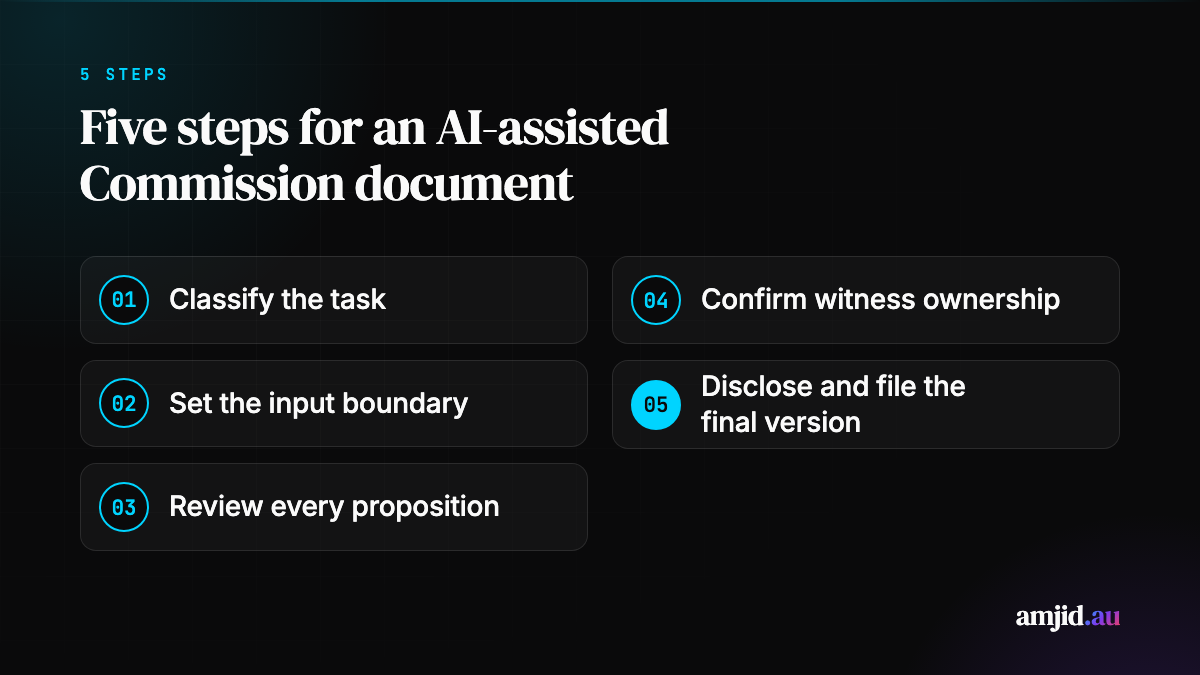
1. Classify the task. Decide whether AI is being asked to organise, draft, edit, translate or research. If the task involves confidential case data, stop and confirm the permitted environment before entering any information.
2. Set the input boundary. Provide only material that the organisation has approved for that tool and task. Keep the case file, evidence and legal advice in the controlled systems selected for the matter.
3. Review every proposition. A person with responsibility for the matter checks facts against records, authorities against the primary source, and arguments against the actual issue. A legal representative should handle legal review where required.
4. Confirm witness ownership. Give each witness an opportunity to correct an AI-assisted statement. Record that the statement is their own knowledge and words before it is finalised.
5. Disclose and file the final version. Include the required AI disclosure and statement of verification. Preserve the final reviewed version and the approval record according to the organisation’s matter-management process.
Corrs Chambers Westgarth noted in October 2026 that strong recordkeeping helps employers respond where an AI-assisted claim broadens or misstates the issues. That is sensible preparation, but it is not a substitute for responding to matters that are properly raised. The Commission still expects a party to engage with the real dispute.
What can happen if the rules are ignored?
The Fair Work Commission says non-compliance may mean a document is given less weight or disregarded. It may also lead to an order to pay costs, or an application or case being dismissed. The available outcome will depend on the particular proceeding, conduct and statutory powers.
Those consequences should not be read as a ban on AI. The Commission’s guidance acknowledges that AI can help people prepare documents more efficiently. Its concern is unsupported material, fabricated authorities and a party treating generated text as a replacement for judgement.
For leaders, the practical standard is straightforward: use AI only where a responsible person can explain the use, protect the information, validate the output and stand behind the final document. That approach reduces avoidable procedural risk while preserving the limited administrative value AI can offer in a controlled case workflow.