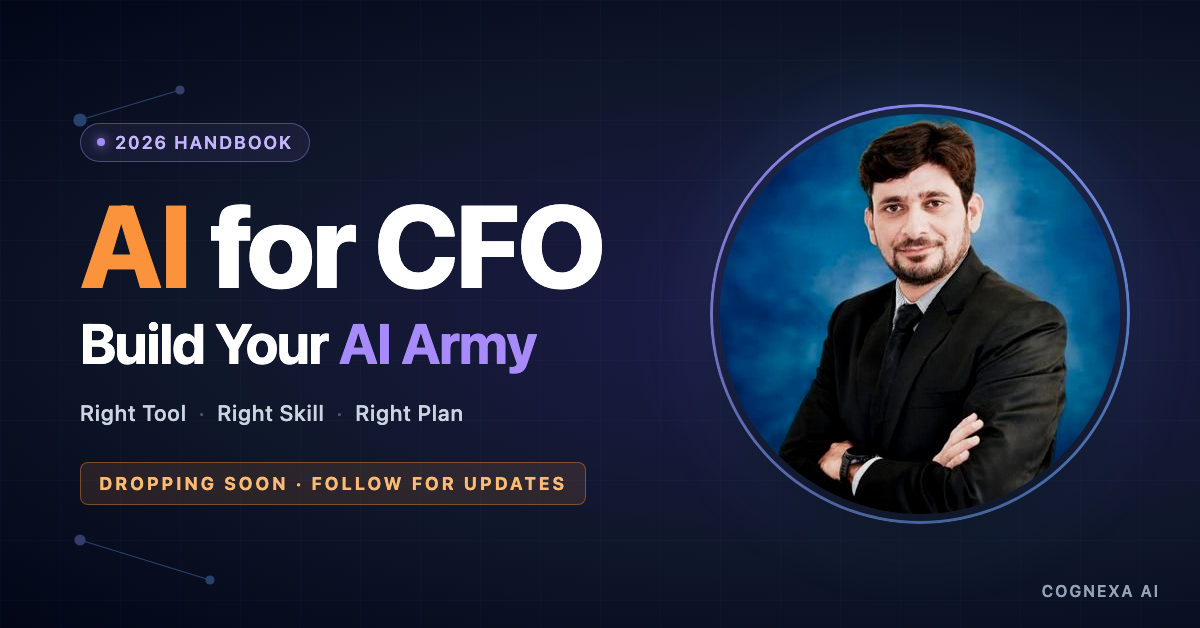
An honest guide for finance leaders evaluating Silvia AI, Nume AI CFO, Finstory AI, AI CFO Office, and the rest of the new AI CFO software wave. Written by someone who builds in this space, not someone who sells slides about it.
Every CFO needs an AI army
After five years working across Machine Learning, Big Data, Generative AI, Agentic AI, and AI Automation, I have one conviction that has only sharpened:
Every department head needs an AI army. Nowhere is the case stronger than in Finance.
Bookkeeping. Accounting. Bank reconciliation. BAS preparation. Accounts receivable. Month-end close. Cash flow forecasting. Audit preparation. These are the workflows where AI does not just save minutes. It gives a CFO back entire days every week.
But here is what most finance teams miss in 2026: AI does not deliver value just because you bought a license.
The CFOs and finance leaders pulling ahead right now are not the ones with the most subscriptions. They are the ones who built a deliberate plan around three things: the right AI tool, the right AI skill, and the right AI plan, all anchored on real process discovery. The teams falling behind jumped to tools before they understood what they were trying to automate.
This post is the public, no-fluff version of the AI for CFO Handbook I am putting together. We will cover what AI for finance actually means in 2026, the state of AI CFO software (including the tools everyone is searching for: Silvia AI, CFO Silvia, Nume AI CFO, Finstory AI, AI CFO Office, and others), how to evaluate any of them safely, and the three-pillar plan to put AI to work inside your finance function.
Why AI for finance is non-negotiable in 2026
In 2026, more than one in three CFO job postings now require demonstrated AI experience, up from roughly 25% the year before. That single number tells you everything about where the profession is heading.
Finance is the perfect home for AI for four reasons:
- Finance teams sit on structured, high-quality data, exactly the kind of input AI handles best.
- Finance has cross-functional visibility. You see every department’s spend, revenue, and operations.
- Finance is already comfortable with technology. Excel, ERPs, BI tools. The leap to AI is shorter than it looks.
- Finance has direct access to leadership, meaning the wins compound across the business, not just within one team.
A finance leader who masters AI does not just become more efficient. They become the AI champion of the entire business. They are the ones the CEO calls when a board model needs rebuilding by Monday. They are the ones HR consults on workforce automation. They are the ones the next CFO seat is offered to.
That is the opportunity. The question is how to capture it without burning months on the wrong tools and the wrong plan.
The 3-pillar framework: right tool, right skill, right plan
Every successful AI rollout I have seen in finance, whether at a sole trader, a Big-4 firm, or a multi-entity group, rests on the same three pillars.
Pillar 1: the right AI tool
Stop tool-hopping. The single biggest mistake I see in finance teams is collecting subscriptions: ChatGPT, Claude, Copilot, Gemini, plus three “AI CFO software” trials, plus a few specialist tools. Each gets used for a week, then forgotten.
Pick one general-purpose AI you will master deeply (matched to your existing stack: Microsoft 365 to Copilot, Google Workspace to Gemini, standalone to ChatGPT or Claude business tier), and one specialist tool for your highest-volume finance workflow. That is it. Going deep on two beats going shallow on six every single time.
Crucial point: when you connect AI to financial data, only business-tier licences are acceptable. SOC 2 Type 2 compliance, encrypted-at-rest tokens, no training on your data. These are non-negotiable. Individual ChatGPT or free Gemini accounts are not safe for client books or company financials, full stop.
If you want a deeper read on how the major general-purpose models actually behave inside finance workflows, see Claude vs ChatGPT vs Gemini agents: which to pick when.
Pillar 2: the right AI skill
Owning a tool is not the same as being able to use it. The skills that separate an effective AI CFO from someone who “uses ChatGPT sometimes” are:
- Prompting craft. Writing prompts that produce auditable, repeatable, finance-grade outputs.
- Validation discipline. Knowing how to spot a hallucinated number, a miscoded GST line, a fabricated formula. AI is a powerful junior analyst, not an oracle.
- Audit-trail thinking. Every AI action your team takes against the books must be reversible, explainable, and logged. If you cannot show the auditor why an entry exists, you do not have an AI strategy. You have a liability.
- Custom agents. Moving from one-off chats to reusable Custom GPTs, Copilot Agents, Gemini Gems, or Claude Skills that encode your firm’s playbooks. This is the single highest-leverage skill almost no one is using yet.
Pillar 3: the right AI plan
This is where most teams fail. They get pitched a 6-month “AI roadmap” by a consultant, or they jump straight from “ChatGPT is cool” to “let’s automate accounts payable.” Neither works.
A real AI plan in finance looks like this:
- Map your processes before you touch a tool (see Process Discovery below).
- Pick one workflow to automate end-to-end. Not five at once.
- Equip the whole team with the same business-tier licence. Solo AI champions do not scale.
- Build re-usable agents for the workflows you repeat weekly or monthly.
- Measure hours saved and reinvest them in higher-value work.
You can run this plan in 30 days. You do not need a consultant, and you do not need new software you have not heard of. You need clarity. The honest unit economics behind this approach are in Agentic AI ROI: the honest numbers.
Process discovery: the hidden lever nobody talks about
Here is the line that separates teams that win with AI from teams that waste a year on it:
You cannot automate what you have not understood.
Process discovery is the unglamorous work of mapping every step in a finance workflow before you try to automate any of it. Where does the data start? Who touches it? What checks happen? What gets approved, by whom, and when? Where do exceptions go? What happens at month-end vs mid-month?
Skip this step and AI will faithfully automate a broken process at scale. You will get the wrong answer faster, with more confidence, and a thinner audit trail. That is worse than not using AI at all. This is the single most-cited reason 95% of AI pilots fail, and the methodology I use to fix it is documented in Process Inventory: the moat nobody maps.
The good news: process discovery in finance is much easier than in other domains because the steps are usually well-defined (invoice in, coded, approved, paid, reconciled). Spend two hours mapping your AP, AR, bank reconciliation, and BAS workflows before you touch any AI tool. Those two hours will save you two months of rework.
The state of AI CFO software in 2026: Silvia, Nume, Finstory, AI CFO Office and more
If you have searched “best AI for CFO”, “AI CFO software”, “AI for CFO Reddit”, or any variation of CFO AI review, you have already discovered that the market is crowded, noisy, and short on honest comparisons. The names that keep coming up:
Silvia AI (CFO Silvia)
The most-searched name in the category right now. If you are evaluating Silvia AI, CFO Silvia, or have asked Google “Is CFO Silvia safe?”, you are not alone. Search volume around the brand is significant, and questions on Reddit threads (“CFO Silvia Reddit”) suggest active interest from buyers wanting unbiased reviews.
What to verify before signing up: SOC 2 Type 2 status, where your data is processed, whether the platform trains models on your inputs, what an audit trail of AI actions actually looks like, and whether every critical action requires explicit human approval. Full breakdown in Is Silvia AI safe? An honest CFO Silvia review.
Nume AI CFO
Another name appearing consistently in CFO-AI search results. Same evaluation checklist applies. Pay particular attention to integration depth with whatever ledger you actually use (Xero, QuickBooks, NetSuite, MYOB).
Finstory AI
Showing up in searches alongside Silvia and Nume. Worth understanding the specific category they are positioned in. Narrative finance and management reporting tools have different needs to true ledger automation tools.
AI CFO Office
Search-visible as a category name and as a product. When evaluating any tool branded “AI CFO Office” or similar, the test is the same: does it write to your books with a full audit trail, or does it only read and recommend?
Virtual CFO AI tools (the broader category)
“Virtual CFO” was a service category long before AI arrived. Today the line between a virtual CFO service and an AI CFO software tool is blurring. Be clear which one you are buying: software you operate yourself, or a service where humans operate AI on your behalf. If you are weighing the service side, my Fractional CAIO brief covers when an embedded AI leader beats a tool subscription.
Where Cognexa AI fits (disclosure: this is what I build)
In the interest of full transparency: I build Cognexa AI, an Australian-built AI accounting platform with twelve specialist agents inside Xero, covering AP invoice processing, batch payments and ABA files, bank reconciliation, BAS preparation, accounts receivable, financial reporting, month-end close, expenses, payroll, audit prep, multi-entity consolidation, and purchase orders. Built for ATO compliance, GST rules, ABN validation against the live ABR, STP Phase 2, and Modern Awards. Human-in-the-loop on every action. Zero autonomous decisions on your books.
I am not pitching it here. I mention it because if you are evaluating any AI CFO software in the Australian market, you should know who is building what. The rest of this post is informed by what I have learned shipping production AI inside real finance workflows, including the weekend build that proved the model and the Xero MCP server architecture that sits underneath it.
How to evaluate any AI CFO tool: the honest buyer’s checklist
Whether you are looking at Silvia, Nume, Finstory, AI CFO Office, Cognexa, or any other AI for CFO software, run every option through these eight questions before you connect it to your books. This is the AI CFO review framework I wish someone had handed me three years ago.
- Is it SOC 2 Type 2 compliant? No exceptions for financial data.
- Does the platform train its models on your data? The correct answer is no.
- Where is your data processed and stored? Country matters for compliance (especially in Australia, the EU, and the UK).
- What does the audit trail look like? You need a tamper-evident log of every AI action, not a chat history.
- Is every critical action human-approved? “Autonomous AI agents” sound exciting in a demo and disastrous in an audit.
- How deep is the integration with your actual ledger? Read-only is a toy. Read-write with full attachments and history is real.
- Is it built for your jurisdiction? GST in Australia is not VAT in the UK is not sales tax in the US. Generic global tools miss the rules that matter.
- What happens when the AI is wrong? Look for confidence scoring, plain-English explanations, and the ability to edit before approval.
If a vendor cannot answer any of these clearly, that is your answer.
Real AI use cases for finance teams (that actually work in production)
Forget the “AI built me a 5-year strategic plan in 30 seconds” demos. Here are the workflows where AI saves real hours, every week, in real finance teams.
Accounts payable
Upload a supplier invoice (PDF or image). AI extracts every field (ABN, line items, GST, bank details), validates the supplier’s ABN against the live register, runs duplicate and fraud checks, matches to the chart of accounts, and queues a draft for human approval. Hours of data entry collapse to a 30-second review.
Bank reconciliation
AI matches unreconciled transactions against outstanding invoices, bills, and spend categories with a confidence score and a plain-English explanation per match. Half the day reclaimed every Monday.
BAS preparation
A pre-lodgement audit that scans the entire ledger, calculates every BAS label (1A, 1B, G1 to G20), bulk-verifies supplier ABNs with the ATO, flags miscoded transactions, and exports an evidence pack for your BAS agent. Two ATO notices avoided is a year of subscription paid for.
Accounts receivable and collections
Aged debtors analysed, payment risk scored per customer, follow-up emails drafted in your tone, and a prioritised collections queue produced, every Monday morning.
Financial reporting
Plain-English questions over live ledger data: “How did revenue change this quarter?”, “Top 10 expenses by account?”, “Gross margin trend?” Answers with charts, in seconds, not days.
Month-end close
Guided checklists, automated journals for prepayments and accruals, depreciation schedules processed, balances validated, variances flagged. Close timelines cut in half are normal, not exceptional.
Audit preparation
Anomaly detection, statistical sampling, substantive testing, and a complete audit trail, packaged into an evidence export before your auditor walks in. Weeks of preparation become hours.
These are not aspirational. These are workflows running in production today, in real Australian businesses. The tools matter less than the discipline of building them workflow-by-workflow with human approval and a clean audit trail. The same discipline scaled to 55+ agents in production at 300% ROI under the AI Factory operating model.
Is AI for finance safe? (a direct answer)
The question behind the searches (“Is CFO Silvia safe?”, “AI for CFO Reddit”, “CFO AI review”) is really one question: can I trust this with my company’s books or my clients’ financials?
The honest answer: AI in finance is safe when three things are true.
- You use a business-tier licence with SOC 2 Type 2 compliance, no model training on your data, and encrypted token storage.
- Every critical action requires explicit human approval. AI proposes, a human disposes. The moment you take humans out of the loop on book-touching actions, you are not running an AI strategy. You are running an unaudited risk.
- There is a complete, tamper-evident audit trail of every AI action: what data was accessed, what decision was made, what the confidence score was, who approved it, and what was written back to the system of record.
Any tool that cannot give you all three should not touch your ledger. Any tool that gives you all three is, on the safety dimension, fine.
The remaining question is whether it does the job well, and that is what the tool-evaluation checklist above is for.
How to build your own finance AI army in 30 days
If you take one thing away from this post, take this 30-day plan.
Week 1, process discovery. Pick one workflow (start with AP or bank rec). Map it. Document inputs, decisions, exceptions, approvers, and outputs. Two hours. No tools.
Week 2, tool selection and licensing. Choose your general-purpose AI (matched to your stack) and one specialist tool for that workflow. Get business-tier licences for the whole team, not just yourself.
Week 3, pilot and prompt library. Run the workflow end-to-end with AI in the loop. Build a prompt library. Build one custom agent for the repeating part. Have a colleague review.
Week 4, roll out and measure. Deploy to the team. Track hours saved. Pick the next workflow.
That is it. The full 30-day plan. No consultant, no six-month roadmap, no twelve-tool stack. Just clarity, the right licences, and the discipline to do one workflow properly before starting the next.
If week 3 is where you get stuck
Most finance people stall at the same point: they can map the process and pick the tool, then hit the part where an agent has to actually call an API, handle an exception, and stop for approval. That is a skill, and it is learnable in a couple of weekends.
Building rather than buying is a genuine option here, and an underrated one. I make the full case in the CFO Silvia review, including why the version you build usually beats the one you subscribe to.
The AI for CFO Handbook, coming soon
Everything in this post is the foundation. The full AI for CFO Handbook will go deeper on:
- A complete prompt library for every finance workflow: AP, AR, bank rec, BAS, reporting, close, audit, payroll
- Tool-by-tool walkthroughs for ChatGPT, Claude, Copilot, and Gemini in finance contexts
- Honest, side-by-side reviews of the AI CFO software market: Silvia AI, Nume AI CFO, Finstory AI, AI CFO Office, Cognexa AI, and others, using the eight-question checklist above
- A safety and compliance playbook for connecting AI to your books
- Real templates for process discovery, custom agents, and 30-day rollout
- Australian-specific guidance: ATO compliance, BAS, GST, STP Phase 2, ABA files, Modern Awards
No vendor fluff. No affiliate pitches. Written by someone who builds in this space.
Follow for updates. The handbook is dropping soon.
If you found this useful, share it with the CFO, finance manager, or bookkeeper in your network who is still stuck doing manually what an AI army could be doing for them by Friday.
Disclosure: the Xero link in this post is a referral link. If you sign up through it, I may receive a small commission at no extra cost to you. I only link to tools I personally use and recommend.